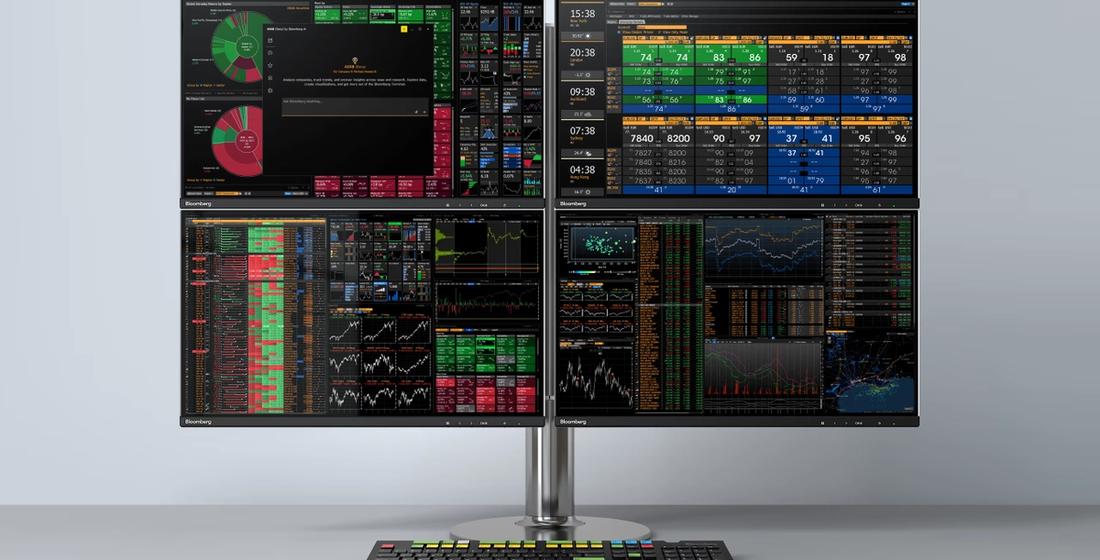
Walk into any investment bank, hedge fund, asset manager, private equity firm, and you are likely to see people staring at the same set of programs. To outsiders, an Excel sheet, Bloomberg, FactSet, and Capital IQ appear to be needlessly complex variations of a spreadsheet. Understanding the purpose of these platforms is a great starting point to understanding a career in finance.
Excel
Microsoft Excel is arguably the most important piece of software in the finance space, as it is here that financial information is organized into models.
Investment bankers utilize Excel to produce valuation models, forecasts, merger models, leveraged buyout models, and other analysis. An analyst can take a company’s historical financial statements, apply assumptions to revenue and expenses, and arrive at an estimated value.
Excel is much more than a basic spreadsheet: functions, pivot tables, Power Query, data modeling, and What-If Analysis help move beyond simple calculations. Microsoft even cites financial forecasting, investment analysis, and financial modeling as uses of Excel. Crucially, Excel rarely provides the information needed for these tasks: it provides the tools to organize and analyze financial information.
Bloomberg
If Excel represents the analysis and modeling side of finance, Bloomberg represents the research and information-gathering portion.
The Bloomberg Terminal provides market data, company data, news, research, analytics, and trading tools for users across asset classes. Bloomberg highlights the comprehensive nature of its Terminal, which covers markets, industries, companies, and securities. A banker could use Bloomberg to access a company’s stock price, debt information, historical financials, comparable companies, or news prior to building a model in Excel.
In addition, Bloomberg offers much more than a basic database: Bloomberg Intelligence provides company and industry research, while the Terminal connects a user to a wider financial professional network.
FactSet And Capital IQ
Bloomberg is not the only player in the financial data space: FactSet and S&P Capital IQ are common alternatives that offer similar tools to research companies, markets, and transactions.
These programs are particularly useful when analyzing companies and comparing financial statements or screening for investment opportunities. When building a comparable company analysis for a stock valuation, an analyst might use these programs to screen for companies within a certain industry, size, revenue, market value, growth, or valuation multiple before exporting the data into Excel.
How They Work Together
The most important detail about these programs is that they are often used together: an investment banker will use multiple programs throughout a single project. Going back to our investment banker analyzing a software company, they may use Bloomberg, Capital IQ, or FactSet to research the company in question and potential competitors before exporting the data into Excel to build a model. Then, a PowerPoint presentation may be created utilizing charts and graphs from Excel to highlight the analysis and recommended course of action.
The actual software is only a small component of due diligence, modeling, or research: a fundamental grasp of financial analysis and what conclusions can be drawn from it are significantly more valuable skills.